Showing posts with label Len Wein. Show all posts

Saturday, 23 October 2010

Incredible Hulk #193. Doc Samson's back.

Incredible Hulk #193, Doc Samson, Herb Trimpe(Cover from November 1975.)

"The Doctor's Name Is Samson!"

Written by Len Wein.
Drawn by Herb Trimpe and Joe Staton.
Lettering by John Costanza.
Colours by Glynis Wein.


It was hard not to feel disappointed when Doc Samson was first written out of The Incredible Hulk. If ever there was a character whose potential'd been left untapped, it had to be the muscle-bound psychiatrist, a hero almost as strong as the Hulk but with a fully-functioning brain. Therefore I suppose it's ironic that the departure of my favourite Hulk artist coincides with the return of one of my favourite supporting characters.

Thunderbolt Ross has brought the psychiatrist in to try and retrieve Glenn Talbot's erased mind. To do it Samson needs two things; Gamma radiation and Bruce Banner. Why he needs either isn't exactly clear but of course no sooner have we been introduced to his mighty Gammatron than it goes wrong. It springs a leak and, hey presto, its creator's got his muscles back, his green hair back and is itching for another scrap with the Hulk. Unfortunately, having sent Samson flying with one punch, the Hulk departs before Samson can get back to the battle site, leaving him to crawl from a hole in the ground, vowing vengeance.

Maybe it's me but Samson seems more macho and gung ho than before. OK, he wasn't exactly short of confidence on his first appearance but this time he seems to have taken the self-belief up a notch. Maybe his mind is affected by the radiation after all. He also seems to have got more action-packed, his fight with the Hulk being much more mobile than it was on their first meeting, as the pair leap around, fling things about and end up slugging it out atop the World Trade Centre.

Joe Staton's inks are strong in more ways than one, giving the tale a drastically different look to that which we were used to for years. In some ways he's a great inker for Trimpe, lending Trimpe's work a visual depth and dynamism it might otherwise lack. In other ways he almost obliterates Trimpe's own style, leaving just hints of it showing through - however much Staton's modified the penciller's work, the Hulk's teeth for instance are still pure Trimpe. Regardless, there's no denying the result looks pleasing, even if Staton's inks were arguably better suited to Sal Buscema who succeeded Trimpe on the strip.

I suppose it would've been nice if Trimpe had gone out with a multi-part epic, featuring all the things he did best; tanks, planes, spaceships, monsters and giant robots. Instead he goes out with a tale whose main function is to set up future events. In that sense it's a little disappointing but, even if it's a mixture of prepping future events and rerunning past ones, it's entertaining enough and moves the strip towards the more action-packed style to come.

And that's it, the end of Herb Trimpe's run, and the end of the blog. Budd's pointed out to me there's one more Herb Trimpe issue, from around a year later, that I wasn't aware of. Sadly I don't yet have a copy of that. So, until I get my hands on it, the blog's done and dusted. I'd like to thank the people who've stuck with it to the end, no matter how gruelling it might have been for you. And, for anyone new, I might as well give a plug to my other blogs Spider-Man Reviewed and Maria McKee's Life Is Sweet, the latter of which has pretty pictures even if you don't want to read the text. Will I be back with another blog? Who can know? Right now, after reviewing over 90 issues of the Hulk, I need a break and, when my feeble mind's recovered, I'll see if there's the fuel in the tank to to tackle something else.

Thursday, 21 October 2010

Incredible Hulk #192. The Loch Fear Monster

(Cover from October 1975.)

"The Lurker Beneath Loch Fear!"

Written by Len Wein.
Drawn by Herb Trimpe and Joe Staton.
Lettering by Ray Holloway.
Colours by Glynis Wein.


I think we've all at some point wondered just what'd happen if the Incredible Hulk met the Loch Ness Monster.

Well, OK, I never have but Len Wein clearly had, as at last we get that titanic tussle. Of course, as we all know, the Loch Ness Monster has very good lawyers, and so names have had to be changed. Thus it is that the Loch Ness Monster becomes the Loch Fear Monster and the Incredible Hulk becomes... ...well, the Incredible Hulk.

Sent back to Earth by the Shaper, the green grappler finds himself in a version of Scotland that only exists in comic books, where everyone talks like Groundskeeper Willie and hangs around in castles. It seems that local fisherman Angus Mactavish is on a mission to kill the dreaded Loch Fear Monster but evil laird of the manor Black Jaimie Macawber (who's white) is out to stop him, fearing the deed would destroy a local economy that relies on the tourism the monster brings in. Needless to say the Hulk can't stand for such appalling behaviour as protecting the local tourist industry and is soon slugging it out with the chaotic kelpie while Mactavish tries to stick an explosive harpoon in it.

It has to be said there are two obvious problems with this tale. The first is its stereotypical portrayal of the Scots. The second is it has its ethics in a twist, as the man we're meant to see as the bad guy is clearly the good guy and the man we're meant to see as the good guy is a raving lunatic. Black Jaimie wants to keep the monster alive in order to save the village and its inhabitants from poverty, while Angus Mactavish wants to kill it because...

Well that's the problem. He doesn't seem to have any reason at all to kill the thing. Is it a threat to him? It doesn't appear to be. Has it killed anyone? If it has it's never mentioned. Because of this, it's hard to see why Len Wein seems to think we should be on his side. At least Captain Cybor, way back in issue #137, had some sort of reason for wanting to kill Klaatu, however demented.

There's also the problem that, for a modern reader, it's hard to read the tale without being reminded of the Simpsons episode where Groundskeeper Willie and Monty Burns try to capture the Loch Ness Monster. Obviously Len Wein can't be held responsible for that - The Simpsons wasn't even a gleam in Matt Groening's eye when this tale was written - but the ludicrous stereotyping of the characters and the OTT melodrama of its climax make it a difficult tale to take seriously. It should also be pointed out that loch monsters are a protected species under Scottish law, so Messrs Mactavish and Banner should be thoroughly ashamed of themselves.

Wednesday, 20 October 2010

Incredible Hulk #191.Toad Men, the Shaper & Glorian

(Cover from September 1975.)

"Triumph Of The Toad!"

Written by Len Wein.
Drawn by Herb Trimpe and Joe Staton.
Lettering by John Costanza.
Colours by Glynis Wein.


Did Blondie singer Debbie Harry really know of what she sang when she said dreaming is free?

It'd appear not, as the Toad Men discover there's a high price to pay for trying to get yourself a handful of dreams. Having secured the Hulk and his friends, the Toad Men tell the Hulk that if he doesn't help them capture the Shaper so they can use his dream-weaving powers to conquer the cosmos, they'll kill Crackajack and Jarella.

So the Hulk takes a bomb to a meeting with the Shaper, and its detonation knocks them both out. But when the Hulk and Glorian go to the Toad Men's world to free the Shaper, the Toad Men react with their usual charm by killing Glorian.

The sight of his friend being killed so destabilises the Shaper that he loses control of his illusions, and the Hulk for the first time sees "Jarella" and "Crackajack" as the alien creatures they really are. The loss of his friends sets the Hulk off on a rampage that leaves the Toad World in ruins and the Toad King Torkon in a heap. The battle done, the Shaper sends the Hulk back to Earth while leaving the Toad Men to face their doom on their no-longer functional planet.

It's difficult to know what to make of this tale. It's certainly more imaginative than most but you can't ignore the fact that the Toad Men are inherently silly. Writer Len Wein certainly can't ignore it as he makes them ludicrous and nasty in evil measures, an inadequate race who get all their technology by stealing it from other, better races. It also has to be said that both the Shaper and Glorian come across as being so dim you're almost glad to see Glorian get shot, just to see the back of his inane brand of gentility.

So, a strange story overall that, in its mixing of the dramatic and ludicrous, reminds me of the kind of thing Steve Gerber might have done. In truth, if this was the first Hulk story I'd ever read, I've no doubt I'd be more than intrigued enough by its oddness to want to read more Hulk comics and, while I'm not sure I'd want to see more Hulk stories in this style, I suppose that means it must have done its job.

Tuesday, 19 October 2010

Incredible Hulk #190. Glorian, Toad Men & the Shaper

(Cover from August 1975.)

"The Man Who Came Down On A Rainbow!"

Written by Len Wein.
Drawn by Herb Trimpe and Marie Severin.
Lettering by John Costanza.
Colours by Glynis Wein.


Still blundering around behind the Iron Curtain, the Hulk meets a man called Glorian who travels by rainbow and takes him to a world that can only be called the Hulk's idea of paradise. It comes complete with the late Crackajack Jackson, Jarella and a whole host of lovely flowers.

It's not real of course. Unknown to the Hulk it's the handiwork of the Shaper who's been convinced by Glorian to use his powers to fulfil the dreams of others in order to bring them happiness.

Well, because it's paradise, everything's fine and dandy for a spell, as the Hulk gets to spend time with his newly-rediscovered friends. But every Eden must have its serpent - or in this case an amphibian - and so it's not long before it all goes wrong, as old foes the Toad Men show up and, looking for slaves, abduct the Hulk and his companions.

Writer Len Wein seems to have set himself a challenge to see how many old characters he can get into one issue of a comic book without it getting over-crowded, and so we get the return not only of the Toad Men (whoever thought they'd be showing their faces ever again?) but also Crackajack Jackson, Jarella and the Shaper. The one new face is that of Glorian who I believe made his debut in an issue of The Fantastic Four. I have to admit I've never read that particular tale and so my knowledge of the character beyond what we see here's somewhat limited. He seems a nice enough bloke, though possibly a little too perfect to be someone you'd actually want to meet.

Another returning fave is Marie Severin who, several years after she departed the strip, returns just as the Herb Trimpe era's drawing to an end. I have to say I can see more of Severin's hand in the artwork than I can Trimpe's, although there's plenty of pointing going on by the various characters so, in that at least, Trimpe's style shows through.

Leaving aside the hints of a gay subtext running through the tale, it's hard to avoid the feeling the strip's moving into a new era. Neither last issue nor this feel like Hulk tales had previously. There seems to be more concentration on the Hulk as a character and more of a stylised feel, as though Wein's looking for a new direction for the title. While, on the art front, Trimpe seems to be gradually becoming more marginalised. In the last few issues, Joe Staton's influence on the look of the strip had become increasingly heavy and now we have Marie Severin's involvement.

In a way, it's a reversal of how Trimpe started on the strip, where he seemed to be being eased into it over a number of issues. He now seems to be being eased out of it the same way. It's a shame. It would've been nice to see Trimpe going out with a full-blooded bang rather than sliding his way sideways out of it but those of us who're Trimpe fans can at least take heart that there's still a few more issues to go before he's receded from the strip completely.

Monday, 18 October 2010

Incredible Hulk #189. The blind girl and the Mole Man

(Cover from July 1975.)

"None Are So Blind...!"

Written by Len Wein.
Drawn by Herb Trimpe and Joe Staton.
Lettering by Artie Simek.
Colours by Glynis Wein.


Yet again the Hulk demonstrates his uncanny ability to speak any language known to man, as he finds himself in a Siberian village and understands everything everyone says to him. Just where did such a stupid character get such an incredible gift for speaking so badly in so many tongues?

Having easily survived the destruction of the Gremlin's stronghold last time out, the Hulk meets a blind girl - Katrina - and befriends her, only to learn her village is raided every night by a horde of strange small creatures who turn out to be the Mole Man's subterraneans. It seems Katrina's scientist grandfather's developed a cure for her blindness and, being all but blind himself, the Mole Man wants it.

The Hulk's not having any of that and, venturing into the Mole Man's underground kingdom, he takes on the villain's diminutive hordes to retrieve the now-stolen medicine. That done, he returns it to the village where, being a comic book cure, it removes Katrina's blindness within seconds.

But here's the rub. When Katrina sees him for the first time, she sees our protagonist not as the Hulk, an ugly and frightening brute, but as the man he really is inside - Bruce Banner. This prompts the Hulk to leave the village behind, tears streaming down his face because, while Katrina may look into his eyes and see a man, the Hulk can see only a monster.

It's a lovely little story that, not for the first time in the strip's history, draws on its Frankenstein roots to engage our sympathies. While that trick might not be new, what is new is the story's told entirely in the First Person by the Hulk. It's a bit of a surprise, given his notoriously foggy memory, to discover the Hulk can actually recall an entire adventure, let alone retell it coherently, but it's a conceit that works and, along with its oddly fairy-tale like mood, lifts the tale well above recent offerings.

Saturday, 16 October 2010

Incredible Hulk #188. Droog & the Gremlin

(Cover from June 1975.)

"Mind Over Mayhem!"

Written by Len Wein.
Drawn by Herb Trimpe.
Inked by Joe Staton.
Lettering by Artie Simek.
Colours by Glynis Wein.


Incredible Hulk #188 might be memorable for many things but the one that leaps out at you like a sore sauropod is the introduction of Droog, the murderous poetic triceratops of terror.

With his love of flinging rhyming couplets at you as he tries to kill you, Droog has to be the strangest creation the strip had yet come up with and, bearing in mind this is the comic that once brought us a giant killer mouth in space, that's quite a boast to make. What the thinking was behind Droog's conception is anyone's guess but you can only suspect Len Wein may not have been totally serious when he first proposed it.

Still, however bizarre the thing may be, it does guarantee that, once read, the story'll never be forgotten, as the attempt to rescue Glenn Talbot from the Gremlin's fortress continues.

Thanks to Clay Quartermain happening to have a bomb concealed beneath his fingernail, the rescue party bust free from their cell and confront the Gremlin who summons Droog to deal with them. As the Hulk fights Droog, the good guys make their escape, just before SHIELD blast the fortress to smithereens.

You can't ignore the fact that SHIELD's actions in annihilating the fortress seem somewhat irresponsible, as they have no way of knowing whether Ross and his gang have actually got out of the place first. In all honesty, I'm not sure SHIELD overall come across as the most reliable organisation in the world. Every one of their agents that we see this issue seems perhaps a little too "flamboyant" and gung ho for the sake of professionalism.

Still, this is a comic book and we know the good guys win through in the end.

And so, minus the Hulk, our gang return to the US with Glenn Talbot's body.

His mind however is another matter, as the Gremlin had swapped it for that of one of his own agents before sending it back to the US in the exploding impostor we saw in issue #185. Because I don't have the intellect of a master-criminal, I don't have the slightest clue why the Gremlin did the mind-swap in the first place. Why didn't he just send Talbot back in his own body? And why was the loyal Soviet agent who now occupies Talbot's body being kept in one of the Gremlin's cells?

So, overall, it's a tale that no sense makes,
But in its insanity, entertainment it never fakes,
And proves there was some creative steam still,
With Wein and Trimpe's hands upon the till.

Blimey, it's infectious.

Friday, 15 October 2010

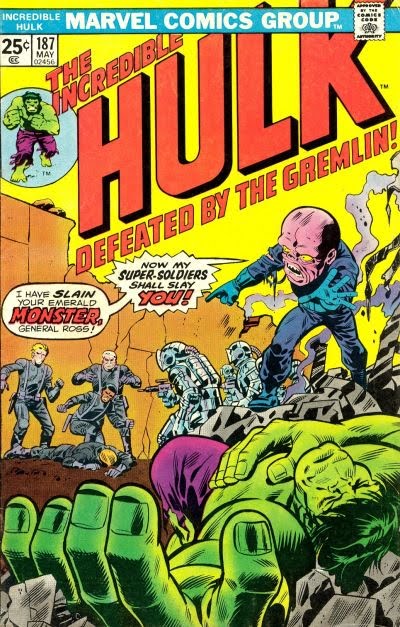
Incredible Hulk #187. The Gremlin's back.

(Cover from May 1975.)

"There's A Gremlin In The Works!"

Written by Len Wein.
Drawn by Herb Trimpe and Joe Staton.
Lettering by Artie Simek.
Colours by Glynis Wein.


Anyone with a functioning brain could see why a man who turns into an uncontrollable monster whenever he gets excited isn't the man to take along on a life-or-death mission to free Glenn Talbot from a Soviet fortress.

Bruce Banner isn't that anyone.

Told he can't go, by Thunderbolt Ross, he stows away on the plane and, inevitably, before the flight's even reached its destination, he's got over-excited and turned into the Hulk.

Exactly what Banner thought he could contribute to the mission is anyone's guess. Leaving aside the Hulk thing, he's a scientist, not a commando and hasn't even had access to the fortress schematics.

Happily, the weapons pod he was hiding in's been jettisoned by this point, meaning Ross and SHIELD agent Clay Quartermain can carry on with their plan.

And it's a plan that works flawlessly right up until the point where they're about to leave the stronghold with the newly liberated Talbot. That's when Ross hands him a gun, and Talbot promptly points it at them to reveal he's not Glenn Talbot at all. He's a Soviet agent and they're now prisoners of the Gremlin.

After some relatively dispensable stories this is something of a return to meatier ways. That's not to say it's original; re-running as it does The Incredible Hulk #164-165 in which Colonel Armbruster and co freed Thunderbolt Ross from Soviet captivity - while the Hulk's run-in with the Gremlin and his armour-clad Super-Troupers re-runs the events of issue #163. There's even a parallel in Clay Quartermain being introduced for the mission, just as Jack Armbruster had been for the Thunderbolt Ross rescue.

Like Armbruster, Quartermain seems rather full of himself and has an annoying gimmick. With Armbruster, it was his pipe-smoking. With Quartermain, it's his rictus grin. Not knowing anything of Quartermain's history before his introduction to the Hulk strip, I don't know what the story is behind it but it don't half make you want to punch him in the face.

Still, despite annoying grins, Bruce Banner's stupidity and a noticeable lack of new ideas, the concentration on the penetration of the Gremlin's fortress makes this a stronger and more focused tale than some we've been getting lately and can therefore be seen as a return to earlier form - even if it rediscovers that form mostly by an act of regurgitation.

Thursday, 14 October 2010

Incredible Hulk #186. The Devastator.

(Cover from April 1975.)

"The Day Of The Devastator!"

Written by Len Wein.
Art by Herb Trimpe.
Lettering by Artie Simek.
Colours by Glynis Wein.


To know know know you might be to love love love love you but to know know know Betty Ross is to court complete and total disaster. If you’re not blown up by a Gamma Bomb, you’ll be blown up by a bomb hidden in your body and if you’re not blown up by that, chances are you’ll be blown up by a Soviet agent.

While Betty frets over the explosive death of her husband, the entire Hulkbuster Base comes under attack from Soviet cats-paw the Devastator. He’s there to destroy all evidence connected to the death of Glenn Talbot, by flattening the place. Sadly, despite his endless boasting, he’s not destined to go down in the annals of Comic Book History, as his power has to be beamed at him by his communist paymasters and he manages to blow himself up at the tale’s climax.

With such a short-lived villain, the real meat of the tale involves the relationship between Betty and her father as they have a heart-to-heart over everything that’s happened to them over the last few years. Interesting that Thunderbolt Ross, once the most one-dimensional of creations, has become by far the strip’s most interesting, sympathetic and complex character.

Speaking of complex, Glenn Talbot’s out to prove he’s got more twists and turns than a conger eel on a log flume. No sooner have we all got over him blowing himself up than it turns out it wasn’t him at all. It was an impostor, which means the real Glenn Talbot may still be alive.

One thing you can say about Betty Ross. She might be deadly but at least life’s rarely dull for those around her.

Monday, 11 October 2010

Incredible Hulk #185. Glenn Talbot blows up.

(Cover from March 1975.)

"Deathknell!"

Written by Len Wein.
Art by Herb Trimpe.
Lettering by Ray Holloway.
Colours by Glynis Wein.


There are two halves to this month's issue of The Incredible Hulk, the first one interesting and the second one not so interesting.

Captured at the end of last issue, Bruce Banner's in a cell at the Hulkbuster Base and, while he's there, gets a visit from the President who's dropped by to check out the base.

But that's when Colonel Jack Armbruster discovers Glenn Talbot's a human bomb on a mission to blow up the President, and both Armbruster and Talbot go ka-boom (or even "Wha-Doomm!") as Armbruster sacrifices himself to save the nation's leader. This prompts Thunderbolt Ross to climb into a very odd contraption and use it to attack the Hulk.

So at last Marvel find a use for Colonel Jack Armbruster which is to kill him. It probably says it all about the lack of point his presence has had in the strip that this is his finest moment. It could be that it was felt that having a character sacrifice himself to save the President was a great bit of drama but my suspicion is Len Wein was simply bored with the character and decided the fastest way to get rid of him was to blow him up.

It'd be nice to say Armbruster'll be missed but, apart from annoying Thunderbolt Ross, it was always hard to see what he was doing there. It's ironic that, only at the moment of his death, thanks to his act of self-sacrifice, does he become an interesting and admirable character who we'd like to know more about.

The second half of the tale's clearly inferior to the first as, such intrigue dispensed with, Thunderbolt Ross reverts to his old-style persona of Man With A Vendetta Against The Hulk. It can be argued he's sent into that mode by the death of his son-in-law but, after his more recent characterisation, it still feels odd - as does his method of stopping the Hulk, which is to, from thin air, produce his own version of J Jonah Jameson's Spider-Slayer, a somewhat clunking, unwieldy device that looks like the wind could blow it over.

On other matters, it's hard to see why Bruce Banner starts the tale in chains as, in his Bruce Banner guise, he's no threat to anyone, and the chains are clearly not designed to hold the Hulk.

If there's anything that reminds us we're reading a tale from the 1970s it has to be the scene where Armbruster's desperately trying to work out how to get one of those new-fangled computer things to produce a print-out. Ah those were the days, when only scientists knew how to do even the simplest task with a computer. Actually I'm starting to miss Armbruster now - and I'm starting to feel a little cheated that we never got to know more about him. If only they'd highlighted his more admirable qualities before the moment of his death...

Sunday, 10 October 2010

Incredible Hulk #184. Shadow boxing.

(Cover from February 1975.)

"Shadow On The Land!"

Written by Len Wein.
Art by Herb Trimpe.
Lettering by Artie Simek.
Colours by Glynis Wein.


Some might argue a strip's scraping the bottom of the barrel when its hero starts having to fight his own shadow, but it's The Incredible Hulk and, as I've said before, the less likely things get the more enjoyable it seems to become.

Here, Kaa, an alien would-be ruler of Earth, takes possession of the Hulk's shadow in order to further his evil plans. Sadly that's as far as his plot for world domination gets as, instead of setting off to conquer the Earth, he just spends all day long fighting the Hulk. As plans go it doesn't seem altogether thought through and I'm not sure from the story whether Kaa's even able to physically separate himself completely from the Hulk, meaning his plan always seemed to be on rocky ground.

In the end, the fiendish shadow's defeated when someone switches on some floodlights and he disintegrates in the multi-directional glare. It's the second issue running a villain from the days of Marvel's monster mags has been revived, and the second issue running said villain's been defeated by an agency other than the Hulk, so repetition could be said to be setting in. Still, the sight of the Hulk fighting his own shadow's fun and, even if there's really not much point to the story beyond that gimmick, it passes the time engagingly enough.

Letterers don't tend to get noticed too much - at least not by me - but credit has to be given to Artie Simek who expands on the theme by giving the Hulk's shadow black speech balloons with white dialogue. I don't know if this was his idea or if it was also used in Kaa's first appearance way back when but, either way, it's effective.

But the real drama this issue comes not from the Hulk's scrap but from the tale's coda, as Bruce Banner shows up at Hulkbuster Base only to be shot, in the second-last panel, by Colonel Armbruster.

I always said he was up to no good.

Saturday, 9 October 2010

Incredible Hulk #183. Zzzax is bax.

(Cover from January 1975.)

"Fury At 50,000 Volts!"

Written by Len Wein.
Art by Herb Trimpe.
Lettering by C Jetter.
Colours by Glynis Wein.


"Hulk will smash glowing monster into little glowing pieces!"

"Argh! Now Zzzax killzz!!"

Yes it's the greatest meeting of wits since George Bernard Shaw met Noel Coward, as Zzzax returns. How he gets back is all a bit silly, as a trio of scientists, helped by Bruce Banner, activate a machine designed to recreate the thoughts of long-dead people by means not quite explained. Unfortunately, the dead "person" whose thoughts they bring back is Zzzax and, as Zzzax is basically living thought energy, that's enough to bring his body back too.

However, in his attack, he absorbs the thoughts of one of the scientists, who just happens to be in love with one of the other scientists and, deciding he too is in love with her, Zzzax climbs to the top of Chicago's John Hancock Center with her. So far this of course owes nothing to any ape-based movie we might've seen. The Hulk sets out to get her back but, in the end, it's the airplane and not the beauty that killed the beast.

It's hard to see it as any more than a not-greatly disguised retread of Zzzax's previous appearance but with Hawkeye removed and the gap filled with elements from King Kong but Zzzax is a fun character and if the way Zzzax is "killed" bears more than a passing resemblance to the way he was "killed" last time out, well, if it works once, you might as well do it again.

So the Hulk's sort of defeated Zzzax, and Bruce Banner's blown his brand new janitorial job. Odd though that Bruce Banner's first instinct when he turns back to Banner at the tale's start is to find employment. Knowing as he does how potentially dangerous he is, I would've thought that, by now, he would've decided the best thing to do in such circumstances is to call General Ross, or the Fantastic Four or Tony Stark or Doc Samson or Peter Corbeau or anyone else with the wherewithal to help him. Is finding a cure really not his first priority in life?

Thursday, 7 October 2010

Incredible Hulk #182. Hammer and Anvil and Crackajack Jackson.

Hammer and Anvil and Crackajack Jackson, Wolverine, Herb Trimpe(Cover from December 1974.)

"Between Hammer and Anvil!"

Written by Len Wein.
Drawn by Herb Trimpe.
Lettering by John Costanza.
Colours by Glynis Wein.


Hammer and Anvil may sound like a bad comedy double-act but they're no laughing matter - as the Hulk discovers when he meets Crackajack Jackson.

Jackson's a travelling musician/tramp who's on his way to visit his son in jail. The trouble is his son's one half of Hammer and Anvil, two escaped convicts who bump into an injured alien and, in shooting it, accidentally save its life whereupon it gives them super-strength by energising the chain that links them. Showing no ambition at all, the pair head straight back to the prison they've just broken out of, in order to fling their weight around a bit.

In the meantime, Crackajack's encountered and befriended the Hulk, and the pair set off for the prison together. Once there, Jackson's accidentally killed when he touches Hammer and Anvil's chain, and the enraged Hulk defeats the duo by snapping that chain, the loss of which sends them spiralling into total and hopeless madness, leaving the Hulk with nothing to do but bury his late friend.

It's arguably the most successful of the Hulk's human interest stories so far. It can be argued that Crackajack Jackson's something of a stereotype, especially in his earliest exchanges but he's also got no agenda. For once the Hulk's befriended someone who isn't a teenager and, for once, the military don't show up to mess it all up. Instead it's the cruel hand of chance that robs the Hulk of arguably the best friend he's ever had. The fact that the Hulk's spent a fair amount of time with Jackson, and is even taught to read and write by him, makes the story more poignant than usual, especially as the Hulk then uses that knowledge to crudely carve Crackajack's name on his tombstone, ensuring that a man who would otherwise have been totally forgotten has a memorial.

The story's also helped by its villains. In the overall scheme of things, Hammer and Anvil may not amount to anything, but the fact they don't like each other and that they cause Crackajack's death by accident rather than design gives them a greater interest than they might otherwise have held. Also, the fact it becomes clear Crackajack's been a negligent parent and is to some degree responsible for how his son's turned out adds depth to his character. He might be the best friend the Hulk's ever had but is clearly deeply flawed. Stories like the Wolverine tale that directly proceeded it may be higher profile and fetch an awful lot more money on Internet auction sites but I'd argue that this is the superior tale and that it's the strongest and most memorable Hulk issue in a long while.

Wednesday, 6 October 2010

Incredible Hulk #181. Wolverine & the Wendigo.

Incredible Hulk #181 Wolverine and the Wendigo Herb Trimpe(Cover from November 1974.)

"And Now... The Wolverine!"

Written by Len Wein.
Drawn by Herb Trimpe.
Inked by Jack Abel.
Lettering by Artie Simek.
Colours by Glynis Wein.


Former British boxing legend Henry "Splash it on all over" Cooper once said a good big 'un will always beat a good little 'un, which shows he hadn't read this issue, as the newly introduced Wolverine knocks out the Wendigo in double-quick time. On the other hand, Wolvie does "Our Henry" proud by getting nowhere at all with the Hulk before he and the green-skinned one are zapped by a potion whipped up by Marie Cartier.

However, before she can transfer the Wendigo curse from her brother to the Hulk, Georges Baptiste takes matters into his own hands and transfers the Wendigo's curse onto himself, taking the wood-beast's place and sparing the Hulk.

It might be Wolverine's first full debut but it feels like a noticeably different character to the one we're used to. His speech patterns aren't the same and he seems to rely on agility and nimble-footedness to fight his foes as much as aggression. There's really little to tie him to the X-Man we're familiar with other than his name, his determination, and his willingness to wave his claws around at any opportunity.

As for his foes, maybe it's just me but I'm disappointed the Wendigo's easier to beat than the Hulk. Frankly I'd have been happy to see Wolvie failing to make any impact at all in his fight against either of them, leading to a three-way fight of total futility before Marie finally intervenes.

So it all ends unhappily, with Marie Cartier regaining her brother but losing the man who loves her. There's a lesson in here for us all, though I'm not totally sure how we should apply it to our own daily lives, but we can say that Georges Baptiste was the best of our little cast although the one least appreciated by those around him. And, if he were here right now, I'm sure that's a lesson Henry "Splash it on all over" Cooper would heartily endorse.

Tuesday, 5 October 2010

Incredible Hulk #180. Wolverine's debut & the Wendigo's return.

Incredible Hulk #180, first ever Wolverine, Wendigo, Herb Trimpe(Cover from October 1974.)

"And The Wind Howls... Wendigo!"

Written by Len Wein.
Drawn by Herb Trimpe.
Inked by Jack Abel.
Lettering by Artie Simek.
Colours by Glynis Wein.


"He's a living, raging powerhouse who's bound to knock you back on your emerald posterior." No it's not the rancher we meet at the start of the issue, it's the character we meet at the end of it.

But more of that later because, again looking for some peace and quiet, the living raging powerhouse the comic's actually named after fails miserably in his attempts to find it as the Hulk lands in Canada and is promptly summoned to a stone hut by Marie Cartier, sister of the man who's now the Wendigo. Having done what's presumably a crash course in shamanism, she wants to transfer the Wendigo's curse to the Hulk and thus cure her brother. But, before she can work her magical machinations, the Hulk and the Wendigo start to fight. It's a battle that's going nowhere, with neither party able to gain the upper hand - and that's when the third combatant joins the fray.

He's known as Weapon X.

He's also known as...

The Wolverine.

And so the most famous X-Man of them all makes his first-ever appearance. Admittedly, it's a somewhat limited debut as we only get to see him in the very last panel but at least we see enough to intrigue us as to just who this character is who's happy to take on both the Hulk and Wendigo at the same time. And if his "ears" are a little too small for those of us familiar with later incarnations, it's an appealing story all round, thanks to the Hulk's battle with a hungry wolf-pack, Marie's dastardly scheming, the appalled Georges Baptiste trying to talk her out of it, and a hotchpotch of magic. We also get the Wendigo who's one of my favourite Hulk baddies.

The tale though does contain possibly the silliest panel in the entire history of the strip as the Hulk and Wendigo run into each other head first, reducing their fight to something resembling comedy status. Still, spirits high, given all that's happened in this issue, it seems next issue's likely to be no laughing matter at all.

Monday, 4 October 2010

Incredible Hulk #179. The Missing Link returns

Incredible Hulk #179, Missing Link returns, Herb Trimpe(Cover from September 1974.)

"Re-Enter: The Missing Link!"

Written by Len Wein.
Drawn by Herb Trimpe.
Inked by Jack Abel.
Lettering by John Costanza.
Colours by Glynis Wein.


We've seen super-villains reform before but the Missing Link puts a whole new spin on the word, as a character we last saw exploding in mid-air returns, his bits and pieces having literally re-formed into the bright pink caveman we all remember.

But if he survived his fall from on high, our other main player has his own plunge to endure.

Sent back to Earth by the Recorder, in a spaceship that seems to have been produced from nowhere, the Hulk loses patience with being inside it and smashes his way out, leading him to plummet several miles into the Appalachian landscape. When he wakes up, it's Bruce Banner who finds himself taken in by a local family; the Brickfords. That's when he finds out he's not the only stray they've adopted because they have a lodger. They call him Lincoln.

And he's the Missing Link.

But it's a different entity from the one we encountered before. Whereas his former incarnation was full of rage and fury, this one, having been taken in by the Brickfords and shown kindness by them, has mellowed into a pillar of the local community.

Still, as the Hulk could tell him, when you're a radiation-spawned monster, life's rarely simple and, despite befriending him, Bruce Banner soon discovers the Missing Link's giving off radiation levels that're endangering everyone around him.

Of course it all leads to a fight between the Hulk and the creature, that, like the last one, ends with the Missing Link exploding. But this time he reforms instantly and, his radiation output back to safe levels, goes off with his friends, leaving the Hulk once more alone.

This is more like it. After the pretensions of the last few issues, we get back to basics as the Hulk comes up against another big ugly monster. Happily, it's more sophisticated than that as we get to see the former menace recast as a good guy, fighting to save his friends from the deadly peril he believes the Hulk to be, while the Hulk thinks he's saving the town from the Missing Link. With its redefining of a former menace, the contrast between the Hulk's outcast status and his foe's acceptance by the society he's found himself in, and the caveman inadvertently posing a deadly threat to his new-found friends, it's easily the best Hulk tale we've seen for a while and, after recent missteps, it's good to see the strip finally back on track.

On the face of it, it's not the only one back on track because Glenn Talbot's finally back on American soil.

But what does this mean for his long-suffering wife?

And just how does it connect to Colonel Armbruster's digital watch blowing a gasket?

Tuesday, 17 August 2010

Incredible Hulk #145. The Sphinx, Colossus and Egyptian gods

Incredible Hulk #145, the Sphinx, Colossus and Egypt
(Cover from November 1971.)

“Godspawn”

Written by Len Wein.
Drawn by Herb Trimpe.
Inked by John Severin.
Lettering by Jean Izzo.


It seems like at some point every Marvel hero has to get signed up to do a movie - and this time it’s the turn of the Hulk who, after destroying large chunks of southern Europe, finds himself in Egypt and blundering onto a film shoot. The genius of a director decides the Hulk's just the thing his historical epic needs (Ancient Egypt presumably having been full of mono-syllabic green monsters) and so the Hulk finds himself on set and in costume.

There’s just one problem.

A bunch of aliens who resemble the Egyptian Gods have turned up, looking to animate two stone titans for a duel that could devastate the Earth. And one of those titans is the Sphinx!

It’s a strange tale, eerie in places, that feels more like a bizarre dream Bruce Banner’s having than any kind of reality. Little in it makes sense. It’s hard to see just why the aliens take Banner aboard their ship. They don’t seem to need him for anything. They just do it for purposes of exposition. Having read Banner’s mind and learned nothing from it that seems to be of any interest to them (even though they’ve learned he’s the Hulk), they then leave him unattended on their ship where he can - and does - sabotage their plans. Beamed back to Egypt, the Hulk then proceeds to routinely tear apart a giant living statue called Colossus who declares that nothing has ever faced Colossus before and survived, despite the fact he’s only just come into existence and therefore nothing has ever faced Colossus ever.

There’s also the problem of events early in the tale where the Hulk sinks a Russian warship and presumably drowns the whole crew then causes a tidal wave that destroys an entire town. Leaving aside the fact I’m not sure Soviet warships ever patrolled the Mediterranean, logically the Hulk must have caused hundreds and possibly thousands of deaths in these two incidents but the story takes no consideration of this at all and both events are instantly forgotten about by both writer Len Wein an artist Trimpe.

The tale also has a fair amount of padding, with a near four page recap of the Hulk’s origin and a three page scene where Thunderbolt Ross tells Glenn Talbot and Betty about his plans for his new Project Greenskin base.

So it’s a story that makes no sense, is arguably 33% padding, ducks the moral issue of the Hulk being a mass-murderer, has a set of villains who do things for no reason at all and, in Colossus, has a monster that poses no threat whatsoever to the Hulk. The Sphinx is a no-show thanks to Banner’s interfering.

The odd thing is that, having said all that, the sheer strangeness of the tale carries it along. And if its multiple flaws mean you couldn’t exactly call it a classic, it is at least odd enough to stick in the memory for as long as a story that was a genuine classic would.